Posts

Meter Bridge

Image
In a meter bridge a resistance of R Ω  and a shunt resistance S Ω are connected as shown, the null point is found to be at 40cm from A If a 12 Ω resistor is connected in parallel with S the null point changes to 50cm Find R and S. 1 st case R / 40=S / 60 R=2S/3 --------------- (1) 2 nd case R / 50= [12S / (12+S)] / 50      (12 Ω and S Ω are connected in parallel )  ie R=12S / (12+S) ---------------(2) solving (1) and (2) S=6 Ω and R=4 Ω

SAI'S SCIENCE AND MATHS CLASSES: Renewable Energy-Solar

SAI'S SCIENCE AND MATHS CLASSES: Renewable Energy-Solar : The conventional energy sources are depleting at an exponential  rate .The energy crisis is a major concern for the nation around. The c...

Renewable Energy-Solar

The conventional energy sources are depleting at an exponential  rate .The energy crisis is a major concern for the nation around. The coal will last long only for 100 years or less petroleum resource will be exhausted nearly in 50 years time. The oil producing countries it self is moving towards the introduction of renewable energy sources , major among them is Solar energy. The energy production in the sun is  by the  nuclear fusion , hydrogen in the core of sun is converting in to heavier nucleus helium during this process the nuclear binding energy is liberating in the form useful energy . The plants can absorb the visible light and utilize it  for photosynthesis . The use of solar energy by natural means is coming only 1 to 2 % , rest of the energy is un utilized The solar energy capturing technique (Photo Voltaic) was introduced by Charles Fritts   in the year 1883 The solar energy can be  utilized in the following ways 1.  ...

Potentiometer (Potential Gradient)

Image
A  10m long wire of 20 ῼ resistance is   used as a potentiometer wire This wire is connected with a 5V battery along an external resistance of 480 ῼ If an unknown emf E is balanced at 600 cm calculate 1) potential gradient 2) the value of E 1)       The total resistance =480+20 = 500 ῼ So the current in the circuit=5/500=1/100 A Potential drop across the wire= 20 × (1/100)=1/5 V . . . Potential Gradient =potential drop per unit length= (1/5) / 10= 1/50 v/m 2)  The unknown emf E= Potential gradient × Balancing length E =(1/50) × 6= 6/50 V

Numericals on Current and Dual nature

Image
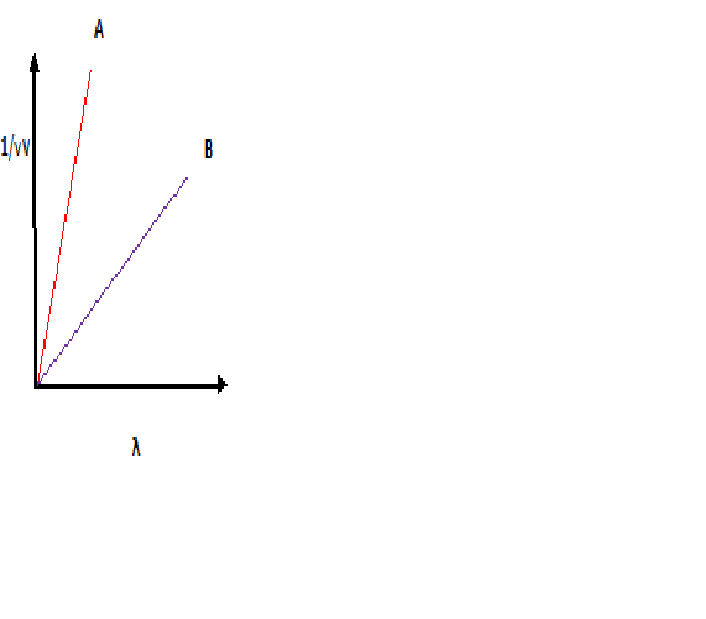
1)  When a steady current flows through a conductor of non uniform cross section which of the quantities remains constant a) Current b) current density c) electric field d) drift speed a) we know that I=Q/ t so current is independent of area of cross section b) current density j = I / A ie current density is inversely proportional to area of cross section c) electric field E = V / l E=IR / l E=(Iρl) /Al E=Iρ / A so E   is inversely proportional to area of cross section d) V d =I / nAe so the drift speed is inversely proportional to area of cross section. 2) The fig shows a plot between  1/ √ V, where V is the accelarating potential Vs de Broglie wave length  λ in the case of two particles having same charge q but different masses m 1 and m 2 with lines A and B which one will have smaller mass λ =h/p =h / ( √ 2mK) λ=h/ ( √ 2mqV) λ=h/ ( √ 2mq) ×(1/  √ V ) (1/  √ V )=( √ 2mq) /h ×  λ slope of the given graph...

Isodiaphers

The two nuclides having the same neutron difference are known as isodiaphers . The neutron difference is otherwise known as isotopic number or isotopic excess. The neutron difference  is the difference between the number of neutrons and number of protons.  eg: A 1 X Z 1 and A 2 Y Z 2 are two nuclides X contains Z 1 protons and (A 1 - Z 1 ) neutrons so its Neutron difference= (A 1 - Z 1 ) - Z 1 =   (A 1 - 2Z 1 ) Y contains Z 2 protons and( A 2 - Z 2 ) neutrons so its Neutron difference= (A 2 - Z 2 ) - Z 2 =   (A 2 - 2Z 2 ) If   (A 1 - 2Z 1 ) = (A 2 - 2Z 2 ) X and Y are isodiaphers . 234 U 90 and 238 U 92 are isodiaphers in both cases neutron number is the same (234-2×90) =54= (238-2×92) The isodiaphers usually  result by an α ( 4 He 2 ) particle emission, the nuclide formed after emission and mother nuclide will be isodiaphers. 238 U 92 ------ à 234 U 90 + 4 He 2 In some cases nuclear number can be zero also. ...

Drift Speed of Electrons In a wire

Two wires X and Y have the same resistivity, but their cross sectional areas in the ratio 2:3 and lengths in the ratio 1:2 They are first connected in series and then in parallel to a dc source Find out ratio of drift speeds of electrons in two wires for the two cases. case i) Series In  series combination current I through each resistor will be the same Current I= neAV d n=number of electrons per unit volume e=Charge of an electron A=Area of cross section of wire V d = Drift speed V d = I /  (neA) V d1 = I  /  (neA 1 )      --------------(1) V d2 = I  /  (neA 2 )      --------------(2) Note that 'ne' is same for both the wires since the resistivity same means same material From 1) and 2) V d1 /   V d2  =  A 2  / A 1 ie   Ratio of drift speed is 3:2  case ii) Parallel In  Parallel combination potential  ' v 'through each resistor will be the same ...